Why leafy greens change the buying decision
Kale, spinach, parsley, mint, chard, and wheatgrass do not move through a juicer like apples or carrots. Leaves are light, flexible, and low in free-flowing liquid. They can float in a large chamber, slip around a fast basket, gather above an auger, or form a thin mat against screen mesh. A machine that looks fast with firm fruit may require a very different pace with a handful of greens.
The useful comparison is therefore mechanical and practical. Look for a feed path that can grip small amounts, a pulp exit that remains observable, a screen that can be reached with a brush, and instructions that explain fibrous ingredients. Then consider how the machine handles the cucumber, apple, celery, lemon, or root ingredients that usually share the recipe. Greens capability is not a badge; it is a repeatable path from washed leaves to finished cleanup.
Single auger is the practical household starting point
A slow single auger pulls prepared produce toward a screen and gives the user a controlled way to alternate textures. The Omega All-in-One uses a horizontal format that rewards deliberate feeding and offers a clear path for small bundles. The Ninja JC151 uses a more approachable household cold-press workflow and suits shoppers whose greens normally appear in mixed recipes. Neither should be treated as maintenance-free or universally clog-proof.
Horizontal machines require counter length for the motor, tray, juice cup, pulp container, and front disassembly. Compact vertical machines use less width but need overhead clearance and a place to remove the bowl. The right orientation is the one that fits both the ingredients and the physical station. A slower motor label alone does not establish greens performance, and an extra-wide opening does not guarantee that loose leaves will feed themselves.
Twin gear is a specialist pathway, not an automatic upgrade
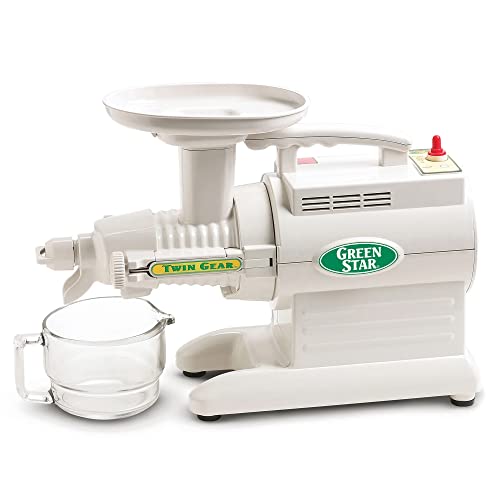
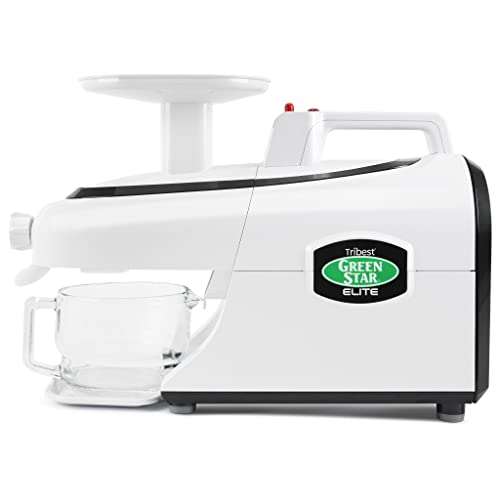
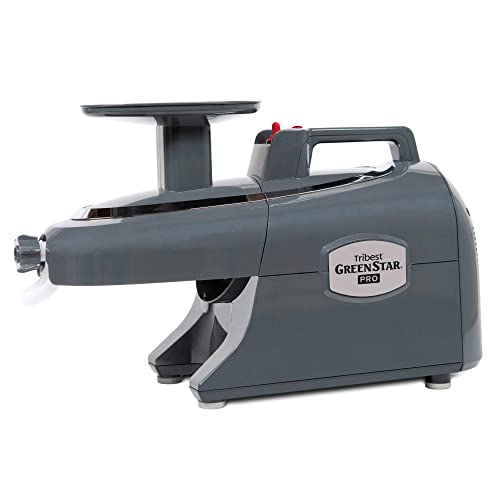
Tribest Greenstar models use two interlocking gears rather than one auger. The verified Original GS-1000, Elite GSE-5000, Pro GS-P502, Greenstar 5 GS5, and Gold GP-E1503 create a controlled horizontal route for leafy and fibrous produce. The Pro and Greenstar 5 are particularly relevant to wheatgrass-focused shoppers because their current manufacturer materials explicitly include wheatgrass among the intended produce.
That specialist route brings more assembly and cleaning. Matched gears must be aligned correctly, the screen and housing must seat as documented, and pressure components add surfaces where fine plant fibers can collect. Choose twin gear when greens or wheatgrass are frequent enough to justify those steps. For an occasional spinach-cucumber juice, a simpler single-auger machine may deliver a better ownership experience even if the specialist model looks more capable on paper.
Wheatgrass deserves a separate shortlist
Wheatgrass is thin, fibrous, and usually processed in smaller amounts than a full mixed-produce batch. A horizontal single-auger or verified twin-gear model is the most natural starting point because it offers controlled feeding and a defined pulp path. JuicerPress does not treat every general cold press as a wheatgrass specialist, and we do not recommend a product for wheatgrass merely because it can process other leafy ingredients.
The Greenstar Pro and Greenstar 5 are the strongest wheatgrass-first options in this verified catalog. Greenstar Original and Elite provide adjacent twin-gear routes, while the Omega All-in-One offers a simpler horizontal single-auger alternative. Confirm the exact model manual, screens, pressure parts, voltage, included accessories, seller, and current listing. A model family name cannot establish what arrives in a particular box.
Kale, spinach, herbs, and chard need different handling
Kale and chard can combine broad leaves with dense or stringy stems. Spinach and tender herbs are smaller and can scatter through a hopper. Clean produce should be sorted so damaged portions and non-food material are removed, then prepared within the exact manual. Some machines benefit from loose, manageable bundles; others specify piece size or ingredient order. Do not force a tightly packed wad into a feed opening.
The supporting ingredient matters. A compatible high-moisture ingredient may help carry leaves through a mixed recipe, while a firm ingredient can help clear soft material when the manual permits alternating. That is a technique choice, not permission to use produce as a ram. If pulp stops, the motor changes sound, or material rises instead of moving, stop feeding and follow the model-specific jam procedure.
Feed control matters more than chute width
Large hoppers are useful for compatible mixed batches, but leafy material can bridge, float, or wrap even when the opening is wide. The Omega Hands-Free can reduce active loading for a planned mixed-produce batch, while the Omega Compact Vertical changes the counter shape. Those advantages should be weighed against bowl size, seals, lid movement, and the number of surfaces that must be rinsed.
A conventional feed throat adds active work but also lets the user stage small amounts and watch how the machine responds. For a greens-first routine, deliberate control can be an advantage rather than a flaw. Compare the normal recipe and the preferred pace, not the advertised diameter alone. Follow the supplied pusher instructions, keep fingers and utensils out of a powered opening, and never defeat a safety interlock.
Yield claims need a fair kitchen method
A universal leafy-green yield percentage would be misleading. Variety, freshness, trimming, starting weight, water on washed leaves, screen choice, pressure setting, feed pace, retained pulp, foam, and measurement method can all change the apparent result. A thicker glass may appear to yield more because it carries more suspended plant material. Comparing unrelated marketing demonstrations does not solve those differences.
For a useful home comparison, weigh equal prepared portions, use the correct configuration for each machine, keep the supporting ingredients and feed method consistent, collect liquid in the same vessel, and record texture as well as volume. Repeat the test across ordinary sessions. Preparation time, active feeding, cleanup time, and how much material remains in the housing belong beside the liquid measurement.
Screen access should decide close comparisons
Fine green particles lodge in screen mesh, pulp outlets, gear teeth, auger grooves, seals, and housing channels. Prompt rinsing is usually easier than removing dried residue later. The best ownership design is one whose dirty surfaces are visible, reachable with the supplied or approved brush, manageable in the sink, and intuitive to reassemble after drying.
Dishwasher guidance varies by model and sometimes by individual part. Removable does not mean dishwasher-safe, and the powered base, cord, and electrical components must stay dry. Tribest manuals distinguish among Greenstar families, so a care instruction for Elite or Pro should not be copied to Original, Gold, or Greenstar 5. Read the exact manual before putting any component in a dishwasher.
Measure the complete greens workstation
A greens station includes a produce bowl, cutting board, feed tray or open hopper, juice cup, pulp container, pusher, brush, sink path, and drying area. Horizontal models need more length; vertical models need height; hopper lids need room to open; twin-gear assemblies need a safe place for matched components. Measure the machine while loading and cleaning, not only while closed.
Also consider weight and storage. A technically capable juicer can become the wrong choice if it lives in a difficult cabinet and must be carried for every small glass. For early use in a shared home, compare the normal motor sound and the noise made by hard supporting ingredients without calling any model silent. Unexpected grinding, odor, leaking, or repeated stalling is a reason to stop and inspect the manual.
Final leafy-greens buying checklist
Choose the Omega All-in-One for controlled horizontal single-auger use, Ninja JC151 for an accessible mixed-recipe path, Omega Vertical for narrower counter width, or Omega Hands-Free for staged batch loading. Choose Greenstar Original or Elite for a traditional twin-gear station, Greenstar Pro for a documented wheatgrass-capable professional-style family, Greenstar 5 for the current flagship pathway, or Greenstar Gold only after confirming the legacy configuration and support.
Before buying, verify the exact model, current seller, included screens and pressure parts, voltage, manual, working dimensions, cleanup sequence, parts path, availability, price, and return terms on the live listing. Then picture a normal week of washing, preparing, feeding, monitoring pulp, brushing mesh, drying parts, and storing the machine. The best greens juicer is the one whose complete routine remains acceptable after the first few sessions.
Sources and further reading
Models relevant to this decision
As an Amazon Associate, we may earn from qualifying purchases.





Frequently asked questions
What type of juicer is best for leafy greens?
A controlled single-auger or verified twin-gear juicer is the strongest starting point. Choose between them by frequency, other ingredients, counter shape, assembly, and cleanup.
Is a twin-gear juicer always better for greens?
No. Twin gear can suit committed greens and wheatgrass routines, but the added alignment and cleaning may be unnecessary for occasional mixed juice.
Can I put loose spinach into a self-feeding hopper?
Only as the exact manual permits. Loose leaves can scatter or bridge, so follow the documented loading amount, ingredient order, and pusher guidance.
Which verified models are most relevant to wheatgrass?
Tribest Greenstar Pro GS-P502 and Greenstar 5 GS5 have current manufacturer positioning that explicitly includes wheatgrass. Omega All-in-One is the simpler horizontal single-auger alternative in this catalog.
How should I compare leafy-green yield?
Use equal prepared weights, the correct configuration, the same vessel, and several ordinary sessions. Record texture, retained material, preparation, and cleanup along with volume.
Why are prices not shown?
Amazon prices, sellers, configurations, and availability change. JuicerPress links to the exact live listing so shoppers can verify current transaction details.
Final verdict
For best juicer for leafy greens and wheatgrass: 9 verified models, compare Omega All-in-One and Ninja NeverClog JC151 only after the ingredient, working-space, and cleanup requirements pass. The better choice is the model whose documented tradeoff fits the routine you will actually repeat.