Compare pitcher reamers, direct-to-glass reamers, two motor-assisted Breville presses, and manual levers for oranges, lemons, limes, grapefruit, and the cleanup that follows.
Know before you buy: Cuisinart labels this carafe family discontinued, so buyers should verify the exact Amazon condition and included glass carafe rather than treating it as current manufacturer inventory.
Dedicated citrus machines extract juice from cut fruit against a cone or pressing surface. The fruit is normally washed, halved across its middle, and presented cut-side down; the rind stays in the hand or press cup while juice passes through a strainer. This short ingredient path is why a citrus specialist can feel simpler than an all-produce machine for breakfast orange juice, lemonade, or cocktail prep.
That specialization is also the boundary. A citrus reamer or lever press does not replace an auger or centrifugal machine for carrots, apples, celery, kale, ginger, or mixed produce. Buying the narrow tool is sensible when citrus is the repeat job. If the weekly basket extends beyond citrus, compare the broader collections or use the Juicer Finder before committing counter space to a specialist.
Electric reamer, assisted press, or manual lever
An electric reamer turns the cone while the user lowers a citrus half onto it. This format is usually compact, familiar, and easy to move. Some models collect juice in an integrated pitcher and provide pulp adjustment; others are designed to deliver juice toward a waiting glass. The hand still positions fruit and applies appropriate pressure, but the motor performs the repeated rotation.
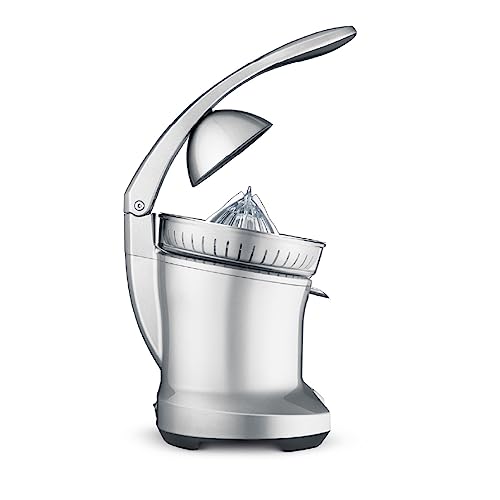
A motor-assisted press combines a powered cone with a press arm, reducing the squeezing motion during repeated servings. A manual lever uses no motor and multiplies pressure through a long handle. Its heavy frame can provide stability and quiet operation, but it needs a dedicated footprint and overhead handle clearance. These are different workflows, not quality tiers: the right one removes the effort that most often stops the routine.
Electric reamer: compact convenience and a familiar everyday rhythm.
Motor-assisted press: less repeated hand pressure with a premium specialist footprint.
Manual lever: quiet controlled pressure with more weight and storage commitment.
Match the cone and press cup to the fruit
Limes, lemons, oranges, and grapefruit vary dramatically in diameter, rind thickness, seed count, and firmness. A cone that feels natural with an orange may be awkward for a small lime, while a shallow reamer area can be messy around a large grapefruit. Reversible cones, universal cones, or model-specific fruit domes can broaden the range, but only the exact product documentation establishes what is included and how it should be used.
Think in proportions, not rare possibilities. If the machine will make orange juice five mornings a week and squeeze a few lemons on weekends, optimize for oranges while confirming that lemons remain comfortable. If cocktail prep is mostly limes, a large press chosen for occasional grapefruit can add unnecessary bulk. The best fruit-size fit keeps the cut half centered and the user's hand clear of moving or pinching areas.
Choose for one glass, a pitcher, or repeated service
A one-glass routine rewards quick setup, a small number of reachable parts, and a spout or vessel that does not create extra transfers. For several servings, container capacity, measurement marks, pulp buildup, seed capture, drip control, and the number of fruit halves processed before a pause become more important. A 32-ounce collection vessel can suit a household batch, while a direct-to-glass design can keep a smaller session nimble.
Do not size the machine for the largest gathering of the year. More capacity can mean a larger pitcher, strainer, lid, and drying footprint every ordinary day. Conversely, a very small collector can make family batches feel interrupted. Count the citrus halves in a normal recipe, identify the serving vessel, and walk through where the filled container will sit and pour before comparing secondary features.
Pulp control changes texture, not extraction category
Citrus households often disagree about texture. Adjustable pulp control can make a compact electric reamer more flexible, while a fixed strainer keeps the decision simple. Openings that admit fine pulp can create a fuller glass; a tighter strainer can feel smoother but may need clearing sooner. Seeds, torn membrane, fruit ripeness, and pressure also influence what reaches the vessel.
Treat pulp preference separately from yield. A glass containing more suspended pulp can look fuller without proving the machine extracted more liquid from comparable fruit. Decide whether the household wants low pulp, some body, or easy adjustment, then inspect how the control and strainer come apart. A feature that is difficult to rinse or reassemble may not earn its place in a daily workflow.
Effort and hand position deserve a real trial
Electric does not mean hands-off. A reamer still asks the user to hold and center each half, maintain pressure, and manage the rind. A press arm changes that motion, while a long manual lever transfers effort to a larger shoulder-and-arm movement. JuicerPress does not make medical or ergonomic guarantees; comfort depends on the user, counter height, fruit, batch size, and exact mechanism.
Before buying, imagine ten or twelve halves rather than one demonstration orange. Note grip, wrist angle, handle travel, splash risk, and the need to empty pulp. Anyone with pain, limited grip, or mobility concerns should seek appropriate professional guidance and choose only a machine they can operate safely. Convenience is valuable only when the appliance is stable and the user's fingers remain clear of the working area.
Counter fit includes the handle, pitcher, and sink
Compact reamers usually need little stored space, but the operating station still includes cut fruit, a board, rind bowl, juice vessel, and a route to the sink. A motor-assisted press needs clear room for its arm and fruit dome. A manual cast-iron lever needs enough base support and vertical clearance for the handle's full arc; moving it for every use may defeat its advantage.
Measure width, depth, operating height, cord reach, spout or pitcher clearance, handle movement, and the space required to remove the strainer. Then measure the sink and drying area. A slender-looking appliance can create awkward parts, while a heavier press can work beautifully if it has a permanent station. Stored dimensions alone never describe the complete citrus workflow.
Plan for sticky residue before it dries
Citrus juice leaves sugar, pulp, oils, and fine membrane on the cone, strainer, fruit dome, spout, and vessel. Prompt cleanup is easier than removing dried residue later. Discard seeds and bulk pulp, remove only approved parts, rinse or wash them by the method stated in the manual, inspect narrow openings, and let everything dry fully before storage or reassembly.
Dishwasher-safe claims are exact-model and exact-part claims. The BLACK+DECKER listing identifies dishwasher-safe parts, but that does not make every citrus machine or every component dishwasher-safe. Keep any powered base dry and never immerse a part the manual excludes. On a manual lever, wipe the frame and examine the press cup, strainer, drip area, and hinge without putting fingers into a pinch point.
Materials, weight, and finish change ownership
A stainless-steel body can support a polished permanent station, while a lightweight plastic housing may be easier to lift from a cabinet. A cast-iron manual press uses mass to resist movement under leverage, but the same mass makes storage and sink-side repositioning harder. Appearance matters in an appliance left out, yet material alone does not prove performance, longevity, duty rating, or ease of cleaning.
Inspect which surfaces actually contact juice and which pieces detach. Citrus acidity and residue make prompt, manual-approved care important regardless of finish. Check the current model number and included pieces because similar names can refer to different configurations. If the press will live beside a wall or backsplash, confirm that the handle, fruit cup, and removable strainer can all be used without scraping nearby surfaces.
Safe operation is part of the buying decision
Use the machine on the stable surface and with the assembly described by the manufacturer. Keep fingers, utensils, loose clothing, and children's hands away from a moving cone or press mechanism. Unplug an electric model before disassembly or the cleaning steps specified by its instructions. Stop for a damaged cord, unusual smell, unstable base, cracked food-contact part, or a mechanism that no longer moves normally.
A manual lever multiplies force, which makes base placement and controlled handle movement essential. Do not bounce the handle, overload the fruit cup, or improvise ingredients and attachments. A dedicated citrus press may look straightforward, but its manual remains the authority for assembly, operation, cleaning, and storage. JuicerPress compares purchase fit; it does not replace those instructions.
Compare value without freezing a changing price
Value depends on how often the specialist replaces hand squeezing and how little friction it adds afterward. An accessible electric reamer can outperform a premium press if it is retrieved, rinsed, and stored easily. A motor-assisted arm can justify more counter space when repeated breakfast batches make hand pressure the obstacle. A heavy manual lever earns its footprint when quiet batch pressing is a real weekly routine.
Amazon prices, sellers, availability, colors, and bundles can change, so JuicerPress does not publish a static price. Read the internal model review to understand mechanism and ownership tradeoffs, then open the verified Amazon destination to confirm the exact model, included parts, seller, current availability, price, and return terms. Do not assume a familiar brand name resolves fruit fit or cleanup.
Use this citrus-juicer buying worksheet
Write down the primary fruit, normal number of halves, desired pulp level, serving vessel, preferred hand motion, acceptable counter commitment, maximum cleanup time, and whether the appliance will stay out. Eliminate any model that cannot comfortably handle the main fruit, the normal batch, or the available working height. Then compare collection method, strainer access, and the effort repeated per half.
Finally, read the exact model review and manufacturer instructions. Confirm cone or cup configuration, controls, collection capacity, removable parts, approved washing, assembly, and safety steps. Use the Juicer Finder to test whether a dedicated citrus machine is truly the right category. A strong shortlist should explain why each product fits and what concrete tradeoff would send the shopper to another format.
Primary citrus size and ordinary number of halves
Electric reamer, assisted press, or manual lever motion
Pulp preference, seed capture, and serving vessel
Operating height, handle clearance, weight, and storage
Strainer access, approved washing, drying, and reassembly
Exact model, included parts, current seller, and current terms
Choose a model pathway
Citrus Juicers separates the shortlist into 3 practical routes: compact electric reamers for everyday citrus, motor-assisted pressing with less repeated hand pressure, quiet manual leverage for a permanent station. Start with the route that matches the dominant routine, then read its exact model review before opening the retailer listing.
Compact electric reamers for everyday citrus
Start here for approachable orange, lemon, lime, and grapefruit routines. Cuisinart emphasizes three pulp settings and a compact lime-to-grapefruit pathway; BLACK+DECKER adds a 32-ounce collection vessel, adjustable pulp control, and listed dishwasher-safe parts.
Motor-assisted pressing with less repeated hand pressure
Choose the Breville Citrus Press Pro pathway when an assisted press arm and dedicated citrus station are more valuable than the smallest storage footprint. It remains a citrus specialist, not an all-produce juicer.
Choose the Zulay cast-iron lever pathway when controlled manual pressure, a stable frame, and motor-free operation suit the routine. Confirm base space, handle clearance, weight, and the removable-strainer cleanup path.
For most households, a compact electric reamer is the most practical citrus starting point. Move to a motor-assisted press when repeated hand pressure is the obstacle, or to a heavy manual lever when quiet controlled batches justify permanent counter space. Let the primary fruit, normal number of halves, pulp preference, vessel, effort, clearance, and cleanup choose the format—then verify the exact current Amazon listing before purchasing.
Use the Juicer Finder to test the ingredient, routine, space, and budget decision before purchasing.
Frequently asked questions
Do you peel oranges before using a citrus juicer?
A dedicated cone or press normally works with washed citrus halves and leaves the rind outside the juice path. Follow the exact model instructions for fruit preparation and never assume the same method applies to an all-produce juicer.
Can one citrus juicer handle lemons, limes, oranges, and grapefruit?
Some cones or press cups accommodate a broad size range, but comfort varies. Confirm the included cone or dome and optimize the choice for the fruit used most often.
Is an electric citrus juicer better than a manual press?
It is better for shoppers who value compact motorized reaming or less repetitive squeezing. A manual lever can be better for quiet, controlled batches when its weight and handle clearance fit the kitchen.
How much pulp will a citrus juicer leave?
Strainer openings, pulp-control settings, fruit condition, seeds, membrane, and pressure all affect texture. Choose the preferred pulp level and inspect how easily the control and strainer clean.
Are citrus-juicer parts dishwasher-safe?
Only when the exact manufacturer instructions identify the exact part as dishwasher-safe. Removable does not automatically mean dishwasher-safe, and a powered base must remain dry.