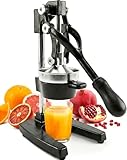
Prepared citrus, home bars, quiet kitchens, and dedicated counter stations.
Choose a lever press whose documented fruit path, controlled motion, working footprint, and removable food-contact parts fit the routine repeated most often.
Curated recommendations
Our manual juicer presses shortlist
3 matched picks
As an Amazon Associate, we may earn from qualifying purchases.
A countertop manual press uses a long handle and linkage to multiply the user's downward force over prepared fruit. Juice passes through a perforated cup or strainer into a vessel below while rind, seeds, and much of the membrane remain in or above the pressing area. There is no motor, spinning basket, auger, feed chute, or cord, so the workflow is quiet and mechanically direct.
That simplicity applies to a narrow ingredient family. The three verified products in this collection are lever presses for prepared citrus. They are not manual versions of a household all-produce auger. If pomegranate, celery, kale, carrots, ginger, apples, or mixed vegetable recipes define the routine, require exact model documentation for that ingredient or start with a compatible preparation method instead of asking a citrus lever to perform the wrong job.
Leverage is useful only when the press is stable
A long handle makes pressing feel controlled because it increases mechanical advantage, but it also applies meaningful force to the base and counter. A heavy cast frame can resist movement better than a lightweight tool, provided it sits on the stable, level surface required by the manufacturer. Weight helps during pressing and complicates retrieval, relocation, and cabinet storage after the session.
Compare the full structure: base footprint, feet, upright, hinge, handle, pressing cup, strainer, and drip platform. Do not steady a moving press by placing fingers near the cup or linkage. If the base rocks, the handle binds, a casting is damaged, or a food-contact piece no longer seats normally, stop rather than adding more force. Stability is an operating requirement, not a premium badge.
Measure the handle arc, not just the base
Manual presses often look compact in a product photograph because the base occupies a modest rectangle. In use, the handle rises above the machine and travels through a broad arc. Upper cabinets, open shelves, a low bar overhang, or a nearby wall can make that motion awkward. The fruit cup also needs front access, and the juice vessel must slide in and out without tipping.
Measure stored width and depth, operating height with the handle fully raised, the forward and rearward travel allowed by the instructions, glass clearance, and the room needed to remove the strainer. Add a cutting board, bowl for prepared fruit, container for spent rind and membrane, and a path to the sink. The complete station decides whether the press is convenient enough to leave accessible.
Match the cup to the fruit used most
Lemons, limes, oranges, grapefruit, and pomegranates vary in diameter, rind thickness, firmness, seed structure, and the way they sit in a pressing cup. A large format may suit orange, grapefruit, and pomegranate portions but feel excessive for a single lime. A smaller cup can center everyday lemons well while limiting the largest fruit portion. Similar-looking presses do not necessarily include identical cups or strainers.
List the primary fruit and ordinary number of pieces before comparing frame finish or price position. Confirm the exact manufacturer's fruit preparation and size guidance. Wash produce, remove stickers and damaged areas, cut only as instructed, and never force a portion that prevents the cup from seating normally. The best capacity is the one that holds the repeat ingredient securely without creating avoidable splash or instability.
Citrus and pomegranate need different preparation
Citrus is generally washed and halved across the middle for a dedicated press, leaving the rind outside the juice path. The press cup lowers over the cut face while the strainer catches seeds and coarse material. Fruit temperature, ripeness, rind thickness, and pressure can change the glass, so no press should be assigned a fixed household yield from a single demonstration.
Pomegranate requires more attention to portion size, white membrane, splash, and stain protection. Follow the exact press guidance about whether and how the fruit can be portioned. Excess membrane can affect flavor, and crushed peel or material outside the intended cup can make cleanup harder. A manual press is useful because it applies controlled pressure; it is not permission to load a whole fruit or improvise beyond the manual.
Compare hand motion across a real batch
One pull in a demonstration does not represent a pitcher. A full session includes lifting the handle, loading each portion, positioning the vessel, lowering the lever smoothly, raising it under control, clearing spent material, and repeating. Counter height, handle length, fruit firmness, hinge behavior, and batch size all influence comfort. A larger press may provide leverage while demanding a wider range of motion.
JuicerPress does not make medical or ergonomic guarantees. Anyone with pain, limited grip, shoulder concerns, or mobility restrictions should seek appropriate guidance and assess the exact appliance safely. For routine shopping, compare ten presses in your mind rather than one. If the repeated motion is the obstacle, a motor-assisted citrus press or compact electric reamer may be the more practical format.
Cup clearance and pour workflow prevent mess
The receiving vessel needs a stable position beneath the outlet, enough capacity for the ordinary batch, and a shape that can be removed without striking the frame. A tall glass may not fit; a wide measuring cup may conflict with the uprights; a shallow cup may splash. The press itself does not solve serving and transfer, so pair it with glassware that fits the actual clearance.
Plan where the full vessel goes before loading the next fruit portion. For pomegranate, protect nearby porous surfaces and clothing from splash according to the household's needs. For cocktail or recipe work, a marked vessel can simplify measuring, while breakfast service may favor a glass placed directly under the outlet. Vessel fit is a first-order buying criterion because it affects every pull of the handle.
Manual is quiet, not silent in every respect
Removing a motor eliminates motor and high-speed basket noise, which can suit early mornings, open kitchens, home bars, or shared spaces. The press can still make normal mechanical sounds as the linkage moves and the cup contacts fruit. A rocking base, grinding hinge, loose component, or sudden change in movement is not a feature of quiet operation and deserves inspection.
Use the placement, assembly, and lubrication or maintenance guidance for the exact model. Do not add household oil, modify the linkage, or tighten hardware without manufacturer direction. The appeal of motor-free operation is a simple controlled mechanism. Keeping that mechanism intact and using it within its intended fruit and batch boundaries matters more than claiming that every manual press is maintenance-free.
Cleaning begins before citrus or pomegranate dries
Seeds, membrane, fine pulp, sticky juice, and rind oils collect on the pressing cup, strainer, rim, outlet, drip area, and receiving vessel. Remove spent material and wash manufacturer-approved detachable food-contact pieces promptly. Use the stated brush, cloth, detergent, water temperature, and drying method. Do not transfer dishwasher claims from one model or part to another.
A manual frame has no motor, but that does not make the entire cast structure submersible. Wipe non-submersible surfaces as directed, keep fingers clear of the hinge, and dry the cup and strainer fully before reassembly. Inspect the underside of the press cup and the points where the strainer seats. The easiest ownership experience is the press whose food path can be reached without moving a heavy wet frame to the sink.
Commercial-style does not prove a commercial rating
A heavy frame, tall lever, stainless-looking cup, or retailer use of the word commercial can describe appearance and workflow without establishing certification, duty cycle, sanitation compliance, or warranty coverage for a business. Home entertaining, a dedicated home bar, and occasional group service are different from continuous restaurant operation. The intended setting must be verified from manufacturer documentation.
For any business use, confirm the exact model's stated use, materials, cleaning requirements, serviceability, warranty, electrical or non-electrical certification where relevant, and applicable local rules. JuicerPress does not imply that these household Amazon listings are approved for a restaurant simply because the machines look substantial. The commercial-style collection addresses throughput and workflow without converting styling into a certification claim.
Cast iron, stainless components, and finish
The verified manual models emphasize substantial cast construction, while particular food-contact cups or strainers may use other materials. A cast frame contributes mass and presence; it does not independently prove extraction, corrosion resistance, food-contact composition, or longevity. A stainless component does not make the whole appliance stainless steel. Read the exact listing and manual rather than generalizing from the finish.
Consider how exposed surfaces will be wiped, whether the removable pieces fit the sink, and where the appliance will air-dry without pooling liquid. Chips, cracks, corrosion, loose fittings, or damaged food-contact surfaces deserve manufacturer guidance. Appearance can matter for a permanent kitchen or bar station, but the fruit path, stability, clearance, and cleaning method should decide before color or shine.
Choose value, balanced, or premium scale without stale prices
The CO-Z Manual Citrus Press occupies the value-focused heavy-duty pathway. The Zulay Cast Iron Juicer is the balanced manual starting point in this catalog. The Eurolux Manual Press represents the larger premium position for shoppers who want a substantial permanent station. These positions describe the verified catalog, not a permanent market-wide ranking, and each has a real tradeoff in weight, scale, or ingredient scope.
Amazon sellers, bundles, availability, colors, and prices change, so JuicerPress does not publish a static price. Read the internal model review first, then use the exact verified Amazon destination to confirm model identity, included cup and strainer, seller, current availability, current price, and return terms. Paying more does not guarantee that the fruit, vessel, handle arc, or sink routine fits better.
Use this manual press buying worksheet
Write down the primary fruit, ordinary number of pieces, largest prepared portion, serving vessel, desired pulp level, counter material, base space, full operating height, handle motion, cleaning limit, and whether the press will stay out. Eliminate any model that fails stability, clearance, cup fit, vessel fit, or a safe movement requirement before comparing finish and price position.
Then inspect the exact model review and manufacturer instructions. Confirm assembly, approved fruit, portion size, removable parts, washing, frame care, replacement support, and intended use. Compare the manual format with the electric citrus hub if repeated leverage is not desirable, and use the Juicer Finder if vegetables or greens enter the plan. A good shortlist explains both the advantage and the reason to choose another mechanism.
Primary fruit, prepared size, and ordinary batch
Stable base and suitable counter surface
Full handle arc, cup access, and vessel clearance
Comfortable controlled motion across repeated pulls
Removable food-contact pieces and frame-cleaning method
Exact model, included parts, seller, and current terms
Choose a model pathway
Manual Juicer Presses separates the shortlist into 3 practical routes: balanced home and bar leverage, value-focused heavy-duty pressing, premium large-format permanent station. Start with the route that matches the dominant routine, then read its exact model review before opening the retailer listing.
Balanced home and bar leverage
Start with the Zulay Cast Iron Juicer when a heavy frame, long lever, detachable strainers, and a balanced manual citrus-and-pomegranate workflow fit a permanent counter position.
Choose the CO-Z pathway when commercial-style leverage and a removable strainer matter at a value position. Verify intended use separately; substantial styling does not establish commercial certification.
Choose the Eurolux pathway when extra-large format, a stainless-steel cup, quiet operation, and a dedicated sturdy counter justify the largest footprint and premium position.
Choose a manual press when prepared citrus or pomegranate is the repeated job, quiet leverage matters, and the appliance can remain stable and accessible. Zulay is the balanced starting point, CO-Z the value-focused heavy-duty path, and Eurolux the premium large-format path. Let fruit fit, base stability, handle arc, vessel clearance, controlled effort, and cleanup select the model—then verify the exact current Amazon listing.
Use the Juicer Finder to test the ingredient, routine, space, and budget decision before purchasing.
Frequently asked questions
What fruits can a manual juicer press handle?
These verified countertop levers are intended for prepared citrus. Other fruit, including pomegranate, should be used only when the exact current model instructions name it and give suitable portion guidance.
Is a manual press better than an electric citrus juicer?
It is better when quiet motor-free leverage and a permanent heavy station fit the routine. An electric reamer is often easier to store, and a motor-assisted press changes the repeated hand motion.
Can a manual citrus press juice vegetables?
No. A citrus lever is not a substitute for an auger or centrifugal juicer. Choose an all-produce mechanism for approved carrots, celery, greens, and mixed recipes.
Does a heavy press need to stay on the counter?
Not necessarily, but frequent lifting can erase its convenience. Weight supports stability during use, so many shoppers will prefer a sturdy permanent position with full handle clearance.
Is a commercial-style manual press certified for restaurant use?
Not automatically. Verify the exact model's intended use, ratings, cleaning requirements, warranty, and applicable local rules before business use.