Start with the citrus-only boundary
A dedicated citrus juicer solves a narrow job exceptionally simply: wash the fruit, cut it across the middle, place the cut surface against a cone or pressing cup, and separate juice from rind, seeds, and some pulp. There is no long feed chute, cutting basket, auger, or external pulp bin to manage. That shorter path can make a fresh orange, grapefruit half, or batch of lemons feel realistic on an ordinary day.
The same simplicity sets the limit. These machines do not process carrots, apples, celery, leafy greens, ginger, or a mixed produce basket. If citrus is only an occasional part of a broader recipe, an all-produce cold press or centrifugal machine may deserve the counter space instead. Use the Citrus Juicers collection for the specialist shortlist and the Juicer Finder when the ingredient boundary is uncertain.
Electric reamers are the household starting point
An electric reamer rotates the cone while the user centers and lowers each citrus half. Compared with hand twisting, the motor takes over the repetitive rotation while keeping the device relatively compact. The category can work for a single lemon, breakfast oranges, or a small pitcher, but the exact cone shape, collection vessel, pulp control, and hand position decide how comfortable the session feels.
The Cuisinart CCJ-500P1 represents the compact adjustable-pulp pathway, with three pulp settings and a documented fruit range from lime through grapefruit. The BLACK+DECKER CJ625 represents a value-focused batch pathway with a 32-ounce container, adjustable pulp control, and listed dishwasher-safe parts. Both remain active-use machines: the user still handles every half and applies appropriate pressure rather than loading a hopper and walking away.
A motor-assisted press changes the hand motion
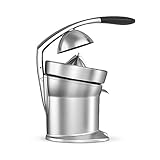
A motor-assisted citrus press pairs a powered cone with a hinged arm or fruit dome. Instead of gripping the rind directly throughout extraction, the user lowers the press mechanism in the manner described by the manufacturer. This can make a repeated orange or grapefruit session feel more controlled and can reduce the squeezing motion that becomes tiresome across many halves. It does not make the appliance automatic.
The Breville Citrus Press Pro 800CPXL is the verified model in this pathway. Its assisted press arm and stainless-steel body suit shoppers who want a dedicated citrus station and accept more counter commitment than a lightweight reamer. The specialist still cannot process non-citrus produce. Measure operating height, arm travel, cup clearance, and the route for removing the cone and filter before choosing it for appearance alone.
A manual lever favors quiet, stable batches
A countertop manual press uses a long handle to multiply force. There is no motor sound, cord, or powered base, and the pressing rhythm can suit repeated halves for juice, lemonade, or cocktail preparation. Its strengths depend on correct placement: a heavy base and controlled handle stroke provide stability only on an appropriate counter with enough clearance.
The Zulay Kitchen Heavy-Duty Cast Iron Juicer is the verified manual model in this citrus shortlist. Its cast-iron frame, lever-assisted pressure, and detachable strainers create a different ownership proposition from an electric reamer. Weight that helps resist movement also makes cabinet storage and sink-side relocation harder. Choose it because a permanent, motor-free pressing station matches the routine—not because manual automatically means simpler in every kitchen.
Match fruit size before capacity or finish
Limes, lemons, oranges, and grapefruit place different demands on a cone or press cup. A large universal cone may center an orange naturally but feel clumsy around a small lime. A compact reamer that handles lemons beautifully may create splash or poor contact with a large grapefruit. Rind thickness, fruit firmness, seeds, and ripeness add variation even within one type.
List the fruit by frequency. Optimize the purchase for the item used several times a week, then confirm that secondary fruit sizes remain practical. Review the exact included cone, dome, or strainer rather than assuming that a similar model name ships with the same pieces. Wash fruit first, cut it as directed, and keep rind, stickers, damaged areas, and any excluded material outside the juice path.
Choose the batch and serving vessel together
A direct-to-glass path can be ideal for a single serving or recipe quantity because it avoids transferring juice through an extra pitcher. An integrated collector can be better for several servings, especially when it includes useful markings and pours cleanly. The vessel must fit under the outlet or into the appliance without crowding the user's hands, and it needs a stable place when full.
Count fruit halves in the ordinary session. For one or two pieces, assembly and cleanup dominate total time. For a family pitcher, pulp accumulation, container capacity, spout behavior, and the frequency of pauses matter more. Do not buy for an annual gathering if it means washing an oversized pitcher every morning. Nor should a tiny collector interrupt the batch that happens every weekend.
Treat pulp control as a household preference
Some people want a smooth glass; others enjoy visible pulp. Adjustable pulp settings can make one reamer useful to both, while a fixed strainer removes a control and may simplify reassembly. Strainer openings, pressure, fruit condition, seeds, and membrane affect the final texture, so a dial does not create perfectly identical results from every orange.
Do not confuse visible body with proven extraction. More fine pulp in the cup can increase apparent volume without establishing that more liquid was removed from comparable fruit. Decide on texture first, then examine how the control, cone, and strainer separate for washing. A preferred pulp setting is valuable only when the parts remain easy enough to clear during the normal batch.
Compare effort across ten halves, not one
A quick demonstration rarely shows the most important ergonomic difference. An electric reamer still requires centering fruit, holding it against the cone, and managing each rind. A motor-assisted arm changes the grip and pressure pattern. A long manual handle shifts the action into a broader lever movement. Counter height, fruit firmness, session length, and the individual user all change comfort.
JuicerPress does not promise that one format will solve pain or mobility limitations. Anyone with a relevant concern should use appropriate professional advice and assess whether the controls, weight, grip, and range of motion are safe. For ordinary shopping, picture a full recipe, where the other hand places spent rinds, when the strainer needs clearing, and whether the appliance remains stable throughout.
The complete footprint reaches beyond the base
A citrus station includes whole fruit, a cutting board and knife, halves waiting to press, a bowl for spent rinds, the appliance, a juice vessel, and a path to the sink. An electric reamer may store easily but still needs overhead hand room. A press arm requires a clear arc. A manual lever can be tall with the handle raised and inconvenient to move repeatedly.
Measure width, depth, operating height, cord reach, handle travel, spout or pitcher clearance, and the space needed to remove the cone and strainer. Confirm that food-contact parts fit the sink and drying area. A heavier press can be an excellent permanent station; a lighter machine can be the better cabinet choice. The winning footprint is the whole workflow, not the smallest number on a specification page.
Make cleanup the final purchase filter
Citrus leaves sticky juice, pulp, seeds, membrane, and aromatic oils on the cone, strainer, fruit dome, spout, and vessel. Prompt cleanup prevents this residue from drying into the openings. Empty bulk material, remove only approved components, wash or rinse by the manufacturer's method, inspect both sides of the strainer, and allow all pieces to dry fully before reassembly.
Dishwasher-safe is a part-specific statement, not a category promise. BLACK+DECKER documents dishwasher-safe parts for the CJ625; that statement should not be transferred to the Breville, Cuisinart, Zulay, or every piece of any machine. Keep a motor base dry. Wipe non-submersible frames as directed. The easiest model is the one the actual owner can clear, wash, dry, and rebuild without postponing the task.
A four-model decision table in plain language
Choose the Cuisinart CCJ-500P1 when a compact electric format and three pulp settings fit the household. Choose the BLACK+DECKER CJ625 when a 32-ounce integrated container and adjustable-pulp batch pathway are more useful. Choose the Breville Citrus Press Pro when an assisted arm and permanent premium citrus station justify more space. Choose the Zulay cast-iron lever when quiet manual pressure and stability outweigh weight and handle clearance.
These are pathways, not permanent rankings. A model can be excellent at the wrong job. Read each internal review for its actual mechanism, strengths, tradeoff, use cases, and current Amazon destination. Confirm seller, configuration, included pieces, availability, price, and return terms on the listing because those details can change after an editorial page is published.
Final verdict and home citrus checklist
Most households should begin with a compact electric reamer because it balances simple storage, motorized rotation, and an approachable halved-fruit workflow. Move toward a motor-assisted press when repeated hand pressure is the leading friction. Choose a manual lever when a stable permanent station and quiet controlled batches are the priority. If non-citrus produce is central, leave this category and compare an all-produce mechanism.
Before purchasing, record the primary fruit, number of halves, preferred pulp, serving vessel, hand motion, maximum working height, storage plan, cleaning limit, and whether the appliance stays out. Eliminate every model that fails a non-negotiable. Use the Citrus Juicers hub to compare all four verified products and the cleaning guide to pressure-test what ownership feels like after the last glass.
Models relevant to this decision
As an Amazon Associate, we may earn from qualifying purchases.



Frequently asked questions
What type of citrus juicer is best for home use?
A compact electric reamer is the practical starting point for many homes. Choose an assisted press for less repeated hand pressure or a manual lever for quiet controlled batches when its weight and clearance fit.
Can a citrus juicer handle grapefruit and limes?
Some cones accommodate both, but comfort can vary across that size range. Confirm the exact included cone or dome and optimize for the fruit used most often.
Do I need to peel citrus before using a citrus press?
Dedicated cone and press machines normally use washed fruit halves with the rind retained outside the juice path. Follow the exact model's preparation directions.
Is adjustable pulp control worth it?
It is useful when household texture preferences differ. Inspect how the control and strainer clean, because a rarely adjusted feature that traps pulp may add more friction than value.
Can a citrus juicer process vegetables?
No. A dedicated citrus cone or lever press is not an all-produce juicer. Compare masticating or centrifugal models for approved vegetables and mixed recipes.
Final verdict
For best citrus juicers for home, compare Cuisinart Pulp Control Citrus Juicer and BLACK+DECKER CJ625 only after the ingredient, working-space, and cleanup requirements pass. The better choice is the model whose documented tradeoff fits the routine you will actually repeat.