Both are true twin-gear machines
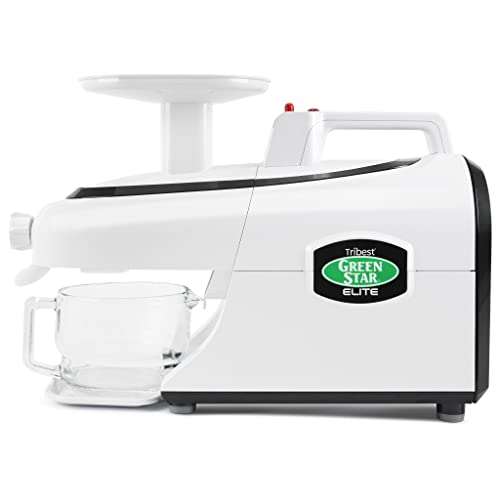
This is not a comparison between a Greenstar label and a conventional single auger. Elite and Greenstar 5 each use two interlocking gears in a horizontal masticating path. The operator aligns a drive and companion gear, installs the correct screen or blank, closes the housing, sets the outlet-pressure component, places juice and pulp vessels, and feeds approved produce through a deliberate path. That format suits committed users who value control with greens, wheatgrass, celery, roots, and mixed produce enough to accept the setup.
The GS5 is newer, but newer does not automatically mean better for every owner. Elite has an established family of documented replacement parts and accessories. Greenstar 5 changes construction and cleanup details. The decision is whether those exact GS5 changes solve recurring friction, not whether a larger model number feels more premium.
Gear construction is the first meaningful difference
Tribest identifies Greenstar 5 with all-stainless jumbo twin gears. The GS5 page describes special pocket recesses and cutting points for hard and stringy vegetables. Elite is documented with stainless-steel twin gears in the site's verified record and operates within the earlier Pro/Elite parts family. Do not reduce the comparison to a vague metal-versus-plastic slogan; confirm the exact gear set, housing, screen, and model compatibility.
All-stainless gear language does not prove a universal yield, durability, or nutrition advantage. Produce freshness, pressure setting, screen, preparation, feed pace, assembly, retained material, and maintenance change results. It does establish a specific construction choice. Choose GS5 when that gear design and the rest of the newer platform matter together. Choose Elite when the established system already fits and replacement compatibility is clearer for the intended ownership plan.
Speed documentation must be read carefully
Elite is documented at 110 RPM. The Greenstar 5 product page and specification materials have shown inconsistent speed wording, so JuicerPress follows the explicit specification-table values used in the prior factual audit: 120 RPM at 60 Hz and 100 RPM at 50 Hz. That distinction matters because the U.S. model normally operates on 60-Hz power. It also demonstrates why a marketing sentence should not overrule a model-specific specification table.
The small numerical difference does not decide the purchase. RPM is rotational speed, not loudness, juice quality, nutrient retention, durability, or yield. Gear geometry, pressure, screen, produce, feed pace, and cleanup matter more. Use the figures to identify the exact platform and expected mechanism, not to invent a ranking.
Greenstar 5 targets cleanup friction directly
Tribest highlights a redesigned twin-gear housing with silicone seals, an integrated drip tray with removable plate, and a screen scraper designed to slide over the mesh. Those are concrete ownership features. They address juice migration, countertop drips, and stubborn screen pulp—three recurring pain points in a twin-gear routine. The GS5 still has two gears, a screen, housing, pressure-control path, feed area, vessels, and small surfaces that must be washed and dried correctly.
Elite uses the established Greenstar Pro/Elite housing and screen ecosystem. It can be cleaned successfully with the supplied or approved brushes and prompt rinsing, but it does not inherit GS5's exact redesigned-housing or scraper claims. If cleanup frustration is the only reason to upgrade, map every part and decide whether the GS5 changes remove enough work to justify changing platforms.
Parts availability favors deliberate model ownership
Tribest maintains a dedicated Elite parts collection with screens, outlet knobs, housings, O-rings, plungers, strainers, pitcher, drip trays, and other model-family components. That visible ecosystem is valuable for a long-term appliance. It does not guarantee that every item is always in stock or that a part fits every GSE suffix. Verify the exact model and part number.
Greenstar 5 has its own current product and support path. Newer does not mean Elite parts will fit GS5, and visual similarity is not compatibility evidence. Keep gears as the correct matched model-specific pair, store screens and blanks by family, and use only confirmed replacements. A buyer planning long ownership should inspect manuals and parts pages before purchase, not after a seal or screen is lost.
Accessories can turn value into clutter
Greenstar systems can extend beyond clear juice through coarse screens, homogenizing blanks, and other approved accessories. GS5's current page highlights homogenizing capability for foods such as nut butter, sorbet, sauces, and pâté, and it lists a glass pitcher and cleanup tools in the platform. Elite has an established accessory family as well. The right comparison is not which box contains more pieces. It is which approved functions the household will repeat and store.
List each planned use over a month. If ninety percent of sessions are green juice, prioritize gear assembly, screen care, pressure adjustment, and the juice-and-pulp station. If homogenizing tasks truly replace another appliance, confirm the included accessory and exact instructions. An unused blank or pasta part is not added value.
Counter and sink planning remain demanding
Both machines create a long horizontal workstation with a feed chute, motor body, front extraction housing, juice vessel, pulp vessel, pusher, and room to remove the gears. The operating footprint is larger than the motor body's rectangle. The wet parts are substantial and can be slippery, so the sink and drying area need stable space. Protect gear teeth and screens from impact and keep components from rolling.
Greenstar 5's integrated drip tray can simplify the countertop reset, but it does not reduce the need for front clearance or a careful drying station. Elite may fit an owner who already has a permanent Greenstar area. Neither is ideal for a user who must lift the machine from a high cabinet for a single small serving and then stack wet parts in a crowded sink.
Use the same assembly discipline on either model
Unplug before disassembly, release outlet pressure in the documented order, support the housing, and remove the screen and matched gears without prying or striking. Note the drive and free-wheel positions and preserve model-specific alignment marks. Clear loose pulp before washing, brush every permitted surface, hold the screen to light, keep the motor base dry, inspect seals and interfaces, and air-dry fully.
Reassembly should require correct alignment rather than force. If the housing does not close normally, remove it and inspect the gears, screen, seals, accessory choice, and residual pulp. Never borrow an Elite diagram for GS5 or the reverse. Similar architecture makes incorrect assumptions more tempting, not safer.
Separate physical facts from health positioning
Tribest provides reliable primary evidence for model names, gear construction, documented speed, parts, included tools, warranty terms, and intended food-processing functions. The company also publishes language about magnetic and bioceramic technology, nutrients, oxidation, freshness, and yield. JuicerPress treats those as manufacturer positioning and does not convert them into medical promises or guaranteed comparative outcomes.
A fair household trial uses equal prepared produce, the correct screen and pressure setting, the same vessel, and repeated sessions. Record texture, foam, retained pulp, preparation, active feeding, screen brushing, housing cleanup, assembly time, and any support needs. The useful upgrade is the one that changes ownership behavior, not the one attached to the broadest marketing claim.
Final Greenstar upgrade test
Choose Elite GSE-5000 when you want the established balanced Greenstar path, its current parts family is reassuring, and the machine's known housing, screens, pressure controls, and cleanup fit a permanent station. Choose Greenstar 5 when all-stainless jumbo gears, the redesigned sealed housing, integrated drip tray, screen scraper, glass pitcher, and current-generation platform solve enough repeated friction to justify the move.
Skip both for occasional juicing, small storage-only kitchens, users unwilling to align and clean twin gears after each batch, or anyone better served by a single auger. Use the exact verified Amazon cards below to compare both offers. Confirm ASIN, model suffix, voltage, condition, seller, included screens and tools, availability, current price, returns, and household-warranty terms before purchase.
Sources and further reading
For product operation, food handling, and other factual claims, we use primary manufacturer, public-health, and clinical guidance as appropriate.
Recommended starting points
These models represent different mechanisms and ownership tradeoffs for this decision. We do not display prices because Amazon availability and pricing can change.
As an Amazon Associate, we may earn from qualifying purchases.

Frequently asked questions
Is Greenstar 5 faster than Greenstar Elite?
Elite is documented at 110 RPM. Greenstar 5's specification table lists 120 RPM at 60 Hz and 100 RPM at 50 Hz. The difference does not prove better yield, sound, or juice quality.
Which model is easier to clean?
Greenstar 5 directly targets cleanup with a redesigned housing, integrated drip tray, and screen scraper. It remains a full twin-gear system requiring prompt, careful cleaning.
Can Elite parts be used on Greenstar 5?
Do not assume compatibility. Verify exact model and part numbers with Tribest; keep gear pairs, screens, housings, and pressure components within their confirmed family.
Which is better for wheatgrass and leafy greens?
Both are serious twin-gear candidates. Choose by assembly, pressure control, cleanup, parts support, and station fit rather than a universal yield claim.
Is Greenstar 5 worth upgrading to?
It is worth considering when its gear construction and cleanup-focused housing solve a recurring problem. Elite remains a strong established choice when those changes do not materially improve the routine.
Final verdict
For tribest greenstar elite vs greenstar 5: gse-5000 or gs5?, compare Tribest Greenstar Elite GSE-5000 and Tribest Greenstar 5 GS5 only after the ingredient, working-space, and cleanup requirements pass. The better choice is the model whose documented tradeoff fits the routine you will actually repeat.