Cold and Cold XL use the same basic extraction class
The most important fact is easy to miss in the names: BJE430 and BJE830 are centrifugal juicers. Produce meets a fast cutting disk and mesh basket rather than a slow auger. Breville's Cold Spin language describes its heat-transfer design; it does not turn either machine into a masticating cold press. Both are strongest when the household wants fast extraction from compatible firm and high-moisture produce and accepts the sound, foam profile, and basket care of a fast machine.
That shared mechanism means the upgrade decision is not about entirely different juice categories. It is about feed opening, controls, construction, physical station size, and whether the XL's specific conveniences change the routine enough to justify its extra space. If leafy greens, wheatgrass, deliberate celery handling, or slow extraction lead the list, compare an auger machine before choosing either Breville.
BJE430 is already a full batch machine
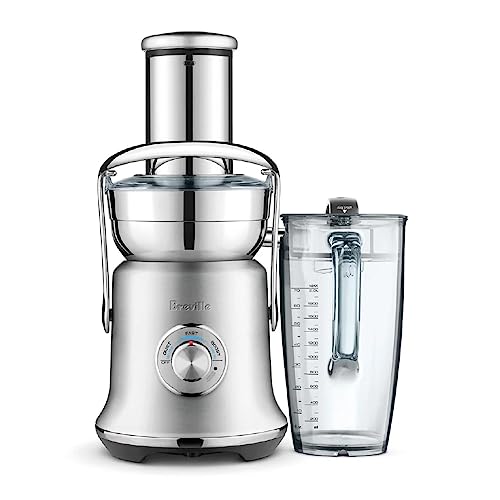
Breville documents a three-inch feed chute, 850-watt motor, 70-ounce Easy Seal jug with froth separator, direct-to-glass nozzle, large 3.6-quart pulp container, stainless-steel cutters, and a micro-mesh basket. The listed body measures 13.6 by 8 by 16.7 inches. This is not a small entry-level appliance. It can stage a substantial batch and store it in the supplied covered jug when the current food-safety guidance and household plan support that choice.
Choose BJE430 when the three-inch opening already accepts the prepared pieces used most, the jug and pulp container match the ordinary serving count, and a simpler control scheme is preferable. Paying for XL makes little sense when the existing chute and capacity do not create a bottleneck. The better value is the machine that meets the real batch without occupying more counter and sink space than necessary.
BJE830 earns XL through chute and control differences
Breville lists a 3.5-inch feed chute for the Cold XL, plus quiet and fast settings, a titanium-reinforced cutting disk, Italian micro-mesh filter, stainless-steel basket, 70-ounce seal-and-store jug, direct-to-glass nozzle, and dimensions of 13.4 by 8.7 by 17.4 inches. The extra half-inch of chute width can reduce cutting for some compatible produce shapes. It does not make every whole fruit safe or appropriate, and it does not eliminate pit, stem, rind, damage, or shape checks.
The control distinction matters more than the shared jug size. Choose XL when fast mode or the maker's exact quiet-setting claim addresses repeated use. Do not interpret quiet as silent or compare it to an auger without a standardized cross-machine test. The BJE830 page says its quiet setting reduces mechanical noise by 40 percent; that is a maker claim tied to this model and setting, not a universal decibel ranking.
Chute width saves only the cutting it actually prevents
Measure the produce used every week. A round apple that fits a 3.5-inch opening may still need inspection or cutting because of shape, condition, pits, stickers, hard stems, or the manual's guidance. Carrots, beets, cucumber, and firm pears often feed predictably when prepared sensibly. Long fibers, loose greens, soft ripe fruit, and awkward chunks can behave differently. Always use the supplied pusher and never hands or utensils in a powered chute.
Run a written prep test before buying: list ten ordinary ingredients and mark which need cutting for BJE430, which would enter BJE830 with less work, and which require the same preparation either way. If the wider opening changes only an occasional apple, it should not dominate the decision. If a large firm-produce batch is repeated several times a week, the accumulated prep difference can be meaningful.
Both 70-ounce jugs require a storage plan
A large covered jug is useful only when the household makes, serves, and stores multi-serving batches responsibly. The listed capacity is a vessel specification, not a guarantee that every recipe fills it or a recommendation to store all juice for a fixed period. Follow current food-safety advice, refrigerate promptly, and treat manufacturer storage language as model positioning rather than a universal rule for every ingredient or person.
The jug also consumes refrigerator, sink, and drying space. If most sessions make one glass, the direct-to-glass nozzle may be more important than the 70-ounce vessel. Include the lid, froth separator, pulp container, basket, cover, pusher, and brush when judging the complete wet set. A bigger capacity can create more cleanup even when the juice portion is small.
Counter footprint is close; operating envelope is not identical
The published body measurements differ by less than the names imply, but Cold XL is wider and taller while BJE430 is slightly deeper in Breville's stated order. Neither number includes a cutting board, produce bowl, jug, pulp-container access, pusher travel, basket removal, or drying area. Upper cabinets can interfere with loading and disassembly, while a wall can obstruct the pulp bin.
Map the station at full scale. Place a 70-ounce jug surrogate, a large pulp container, and the cutting board. Make sure the user can lift the basket safely and carry it to the sink without crossing the cord. BJE430 wins when it fits the available station cleanly. BJE830 wins only if the wider chute or settings add value without making operation cramped.
Basket cleaning is the ownership constant
Both machines rely on a fine mesh basket and cutting disk. Bulk pulp moves to the container, but fine particles remain in the mesh and around the cover and juice path. Stop and unplug as directed, handle the sharp basket carefully, remove loose pulp, brush the mesh from approved directions before residue dries, wash the detachable parts according to the exact manual, and air-dry completely. Keep the base and electrical components dry.
Cold XL's larger positioning does not mean less cleaning, and BJE430's narrower body does not make the basket less important. Compare access, grip, sink fit, and how the brush reaches the full circumference. A fast extraction session followed by a neglected screen is not a fast complete routine.
Sound needs the right evidence
Cold XL has an exact manufacturer statement about mechanical-noise reduction on its quiet setting. BJE430's page does not provide the same model-specific percentage. That difference can support an XL choice for an open kitchen, but it should not become a claim that XL is inaudible, apartment-proof, or quieter than every alternative. Recipe load, surface stability, room reflections, duration, basket condition, and produce impacts all affect the experience.
If noise matters, compare the entire session: cutting, motor run time, produce impacts, container handling, basket brushing, and cleanup. A shorter high-speed session may be acceptable even when it is more intense. An auger may sound calmer but run longer. The correct comparison is model, setting, load, duration, and room—not RPM or one adjective.
Do not use speed claims as a nutrition score
Breville publishes Cold Spin, temperature-transfer, and speed positioning for these models. Those are maker statements tied to the company's tests and descriptions. JuicerPress uses them to explain the intended design but does not promise nutrient retention, health outcomes, or superiority over slow press machines. Ingredients, freshness, preparation, time before drinking, foam, temperature, and storage all influence the finished serving.
For a home comparison, use equal prepared produce and identical vessels, then record preparation, active feeding, run time, texture, foam, visible pulp, retained material, basket cleaning, and final reset. Do not compare BJE430 and BJE830 using unrelated marketing demonstrations. The useful result is whether XL removes enough work to matter, not whether a single glass appears slightly different.
Final BJE430 versus BJE830 decision
Buy BJE430 when the three-inch chute, 70-ounce jug, direct-to-glass option, pulp capacity, and simpler batch station already satisfy the household. It is the disciplined choice when XL's extra half-inch of opening and additional settings would not change the ingredients or schedule. Buy BJE830 when a repeated large firm-produce batch benefits from the 3.5-inch chute, the quiet setting is specifically useful, and the larger operating envelope fits comfortably.
Open both exact Amazon routes below and compare model number, condition, seller, included jug, nozzle, brush, voltage, finish, availability, current price, return terms, and warranty. Breville's own page showed a current availability difference when checked on September 20, 2026, which illustrates why JuicerPress does not publish stock or static prices. Retailer inventory can differ and change again.
Sources and further reading
For product operation, food handling, and other factual claims, we use primary manufacturer, public-health, and clinical guidance as appropriate.
Recommended starting points
These models represent different mechanisms and ownership tradeoffs for this decision. We do not display prices because Amazon availability and pricing can change.
As an Amazon Associate, we may earn from qualifying purchases.

Frequently asked questions
Are BJE430 and BJE830 cold press juicers?
No. Both are centrifugal juicers. Cold Spin is Breville's design language and does not mean a slow auger mechanism.
Which model has the wider chute?
BJE830 Cold XL has a listed 3.5-inch chute; BJE430 has a listed three-inch chute. Preparation still depends on produce shape and the manual.
Do both include a 70-ounce jug?
Breville documents a 70-ounce seal-and-store jug for both exact models. Confirm included components on the current retailer offer.
Is Cold XL quieter?
Breville states that BJE830's quiet setting reduces mechanical noise by 40 percent. Treat that as an exact manufacturer claim, not a standardized cross-brand decibel ranking.
Which is easier to clean?
Both require careful mesh-basket cleaning. The practical difference depends on sink fit, basket handling, and whether the larger XL workflow adds parts or space the household does not need.
Final verdict
For breville juice fountain cold vs cold xl: bje430 or bje830?, compare Breville Juice Fountain Cold and Breville Juice Fountain Cold XL only after the ingredient, working-space, and cleanup requirements pass. The better choice is the model whose documented tradeoff fits the routine you will actually repeat.