Start with mechanism, not the Breville badge
Breville's seven verified families in this catalog do two fundamentally different jobs. Five Juice Fountain models use a fast centrifugal cutting disc and mesh basket for compatible fruits and vegetables. Two Citrus Press models use a powered cone and press arm for halved citrus. That boundary matters more than finish, wattage, or the position of a model in the range. A shopper making apple-carrot juice before work should compare the five baskets. A shopper making orange, lemon, lime, or grapefruit juice should compare the two presses. A shopper whose weekly basket centers on celery, wheatgrass, kale, or a multi-purpose nutrition system should also compare a slow auger outside the Breville family. Begin with one ordinary recipe, the number of servings, and the cleanup that follows. Eliminate the wrong mechanism before comparing chute size, jug capacity, speed settings, or materials. Brand familiarity is useful only after the machine's physical extraction path fits the job.
Juice Fountain Compact: smallest current Breville basket path
The BJE200 Juice Fountain Compact is the Breville route for limited counter depth and one or two fast servings. Breville lists a three-inch feed chute, a 25-ounce jug with froth separator, a heavy-grade polymer body, stainless-steel cutters, and dimensions of 9.1 by 9.8 by 15.7 inches in the maker's width-depth-height order. Its pulp collection sits within the body instead of extending to a large external bin. That can make the workstation easier to contain, but compact never means clearance-free: measure loading height, the locking arm, jug placement, access to the integrated pulp area, and the path to the sink. Choose it when compatible firm produce, speed, and a smaller stored footprint matter more than a large sealed batch jug. Keep comparing when the normal routine is several servings, frequent leafy greens, or a large quantity of pulp that would make repeated stopping and cleaning the compact body inconvenient.
Juice Fountain Plus: the conventional two-speed middle ground
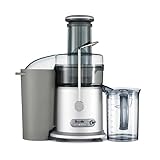
The JE98XL Juice Fountain Plus is the familiar general-purpose Breville centrifugal path. It makes sense for shoppers who want a broad feed route and two-speed control without moving to the Cold-series jug and body layouts. Use the lower or higher setting only as the current instructions direct for the ingredient; the existence of two settings is not permission to force dense produce or overload the chute. The external pulp container and separate juice vessel create a larger active station than the Compact, but they also make the pulp path easy to see during a session. This is the balanced choice when apples, carrots, beets, cucumber, and similar compatible produce dominate and a normal batch does not justify the largest jug. It is not automatically better than the Compact, and it is not a substitute for a cold press simply because the household wants less visible foam. Compare the complete prepare-run-brush-rinse-dry cycle, not only the seconds the motor is running.
Juice Fountain Cold BJE430: three-inch Cold Spin workflow
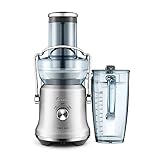
The BJE430 Juice Fountain Cold adds Breville's Cold Spin Technology and a three-inch feed chute to a mid-size centrifugal workflow. On the verified Amazon listing, the exact silver model is BJE430SIL, ASIN B016J1ICDU. The maker describes juice moving through the cutting disc and Italian-made mesh filter while limiting heat transfer; that design language should not be converted into a claim that the machine is masticating, silent, nutritionally superior, or medically beneficial. Its practical position is between the conventional Plus and the larger Cold Plus or Cold XL. Choose it when a broad chute, firm-produce speed, and a seal-and-store vessel suit the normal batch, but the largest body and jug would be excessive. Expect the basket to collect fine pulp and plan to use the supplied cleaning approach promptly. Inspect every apple, remove pits and material excluded by the manual, and cut awkward produce whenever safer, steadier feeding calls for it even if the opening can accept a larger piece.
Cold Plus versus Cold XL: two different large-batch stations
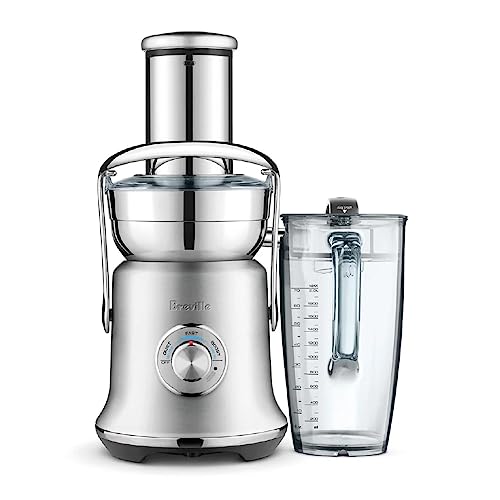
The BJE530 Juice Fountain Cold Plus and BJE830 Juice Fountain Cold XL both use a 3.5-inch chute and a 70-fluid-ounce jug, but their layouts and controls create different ownership decisions. Breville places the Cold Plus pulp bin behind the base, a shape intended to use counter space differently from a conventional side-bin design. The Cold XL is the larger performance-oriented path and includes quiet and fast settings; Breville states that its quiet setting reduces mechanical noise relative to the model's fast operation, not that the machine is silent or directly comparable to every other juicer by decibel level. For either model, a 70-ounce vessel is only useful when the household routinely makes enough juice to benefit. Measure the jug, pulp bin, loading clearance, basket-removal arc, sink, brush area, and drying zone. Choose Cold Plus when its rear-bin layout fits better. Choose Cold XL when the largest repeated batch and its control options justify the larger station.
Citrus Press BCP600 versus Citrus Press Pro 800CP
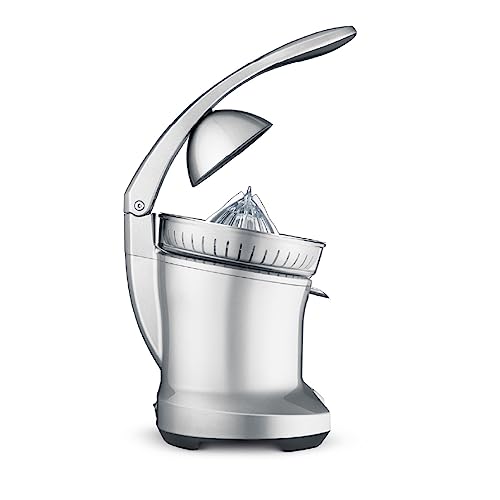
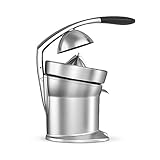
Both Breville citrus presses use a motorized cone, press arm, safety switching, and a drip-stop spout, but they are not the same construction tier. The BCP600 is the lighter polymer-body path. Breville documents a one-size cone for lime through grapefruit, a dual-switch safety arrangement, a removable magnetic fruit dome, and dishwasher-safe guidance for the cone, juice collector, juice filter, and fruit dome. The 800CP Citrus Press Pro adds a solid die-cast base, an acid-resistant die-cast cone, a stainless-steel filter basket, and a soft-grip handle. Choose BCP600 when one-handed citrus assistance and a simpler body meet the routine. Choose the Pro when the heavier construction and permanent counter presence are specifically valuable. Neither machine processes apples, carrots, celery, greens, or unhalved mixed produce. Both require cut-side placement, comfortable arm travel, a stable surface, and prompt clearing of seeds and pulp. Confirm the exact part-by-part wash guidance rather than assuming that every removable component belongs in a dishwasher.
Preparation and feed size: use the manual as the ceiling
Breville's three-inch and 3.5-inch chute descriptions can reduce cutting for compatible produce, but opening width is not a universal whole-produce rule. Wash and inspect ingredients, remove stickers, pits, stones, hard stems, damaged areas, and any peel or rind the exact instructions exclude. Consider shape as well as diameter: a piece that technically fits can still feed unevenly or rotate awkwardly. Use the supplied food pusher and never hands or utensils in the chute. Dense roots should move at a pace the motor and basket can clear; long fibers and loose greens may require different preparation or a different mechanism entirely. For citrus presses, halve fruit cleanly, keep fingers away from the cone, and let the dual-switch design work as intended. A fair comparison counts cutting time, active feeding, pulp-bin pauses, and vessel changes. The machine with the largest opening is not the best choice when its body or cleanup overwhelms the ordinary serving size.
Basket, pulp, cone, and strainer cleanup
Centrifugal and citrus machines concentrate residue in different places. A Juice Fountain's cutting disc and fine mesh basket need prompt attention from both sides, while pulp also collects in the lid, channel, bin, jug, and around seals. Unplug as directed, separate only approved removable parts, clear loose pulp, and use the correct brush before residue dries. A Citrus Press concentrates seeds and pulp around the cone, dome, filter basket, and spout. Lift approved parts carefully, clear the strainer, wipe the non-submersible body, and dry the assembly fully. Dishwasher claims must remain tied to the exact model and exact part: Breville explicitly identifies dishwasher-safe elements on some models, but that does not make every food-contact piece or every Breville juicer dishwasher-safe. The best ownership choice is the cleanup sequence the household will perform immediately after an ordinary session. Large capacity saves little if an oversized basket and jug are repeatedly left dirty.
Counter space, vessels, and ordinary batch size
Measure a Breville juicer as a working station. Record stored width, depth, and height, then add the space to load the chute or lower the citrus arm, position a prep bowl, remove the pulp bin, slide out the jug or glass, unlock the cover, lift the basket, and carry wet parts to the sink. Manufacturer dimensions use a stated order; preserve that order rather than silently swapping width and depth. A compact body can still be tall beneath a cabinet, while a large model can fit neatly if its pulp bin faces the open side of the counter. Batch capacity should describe what is made most weeks, not the largest hypothetical party. One or two servings can make a 70-ounce jug unnecessary. Several household servings can make a small integrated pulp system feel interruptive. Citrus volume is measured in fruit halves, arm repetitions, strainer clearing, and glass changes rather than feed-chute size. Buy around the median session.
Final Breville buying checklist
First choose centrifugal or citrus. Then write the primary ingredients, ordinary servings, maximum cutting time, acceptable motor sound, preferred vessel, available operating space, pulp capacity, screen or cone cleaning, drying space, storage plan, and physical comfort with the pusher or press arm. For a Juice Fountain, compare Compact, Plus, Cold, Cold Plus, and Cold XL only after the same recipe and cleanup sequence are applied to each. For citrus, compare BCP600 with 800CP by construction, weight, arm feel, strainer, and counter commitment—not by the assumption that premium materials guarantee better juice. Open the exact model review before the retailer. On Amazon, verify the ASIN, condition, finish, seller, included accessories, voltage, current availability, price, shipping, returns, and warranty terms. JuicerPress does not sell, ship, warrant, refund, or process returns. The final choice should have one sentence naming the routine it improves and one sentence naming the tradeoff the household accepts.
Sources and further reading
Models relevant to this decision
As an Amazon Associate, we may earn from qualifying purchases.


Frequently asked questions
Are Breville Juice Fountain Cold models cold press juicers?
No. The BJE430, BJE530, and BJE830 are centrifugal machines using a cutting disc and mesh basket. Cold Spin is Breville's heat-transfer design language, not a slow-auger mechanism.
Which Breville juicer is best for a small kitchen?
The Juice Fountain Compact is the smallest current basket path in this catalog, but measure its 9.1 by 9.8 by 15.7-inch maker-listed footprint plus loading and cleaning clearance.
What is the difference between Cold Plus and Cold XL?
Both have a 3.5-inch chute and 70-fluid-ounce jug. Cold Plus emphasizes its rear pulp-bin layout; Cold XL is the larger path with quiet and fast settings.
Which Breville citrus press should I choose?
Choose BCP600 for assisted one-handed citrus work in a polymer body. Choose the 800CP Pro when its die-cast base, die-cast cone, and stainless filter basket justify the extra counter commitment.
Can a Breville citrus press juice vegetables?
No. Both Breville Citrus Press models are dedicated to compatible halved citrus and do not replace a centrifugal or slow-auger all-produce juicer.
Why are current prices not listed?
Amazon prices, sellers, finishes, and availability can change. Verify the exact current offer only after the model's workflow fits.
Final verdict
For breville juicer buying guide: compact, cold, xl, and citrus presses, compare Breville Juice Fountain Compact and Breville Juice Fountain Plus only after the ingredient, working-space, and cleanup requirements pass. The better choice is the model whose documented tradeoff fits the routine you will actually repeat.