A family juicer solves coordination, not just volume
Family fit starts with the drinks people will actually share. Record the dominant ingredients, number of servings, pulp preferences, morning schedule, available counter space, and who cleans the machine. A large chamber is wasted when family members want incompatible recipes. A compact model can be sufficient when one adult makes two glasses at a time. The right machine reduces repeated points of negotiation instead of merely holding more produce.
Keep operation with a responsible adult and follow the exact manual. Safety locks, covered feed openings, and supplied pushers do not make a juicer a child-operated appliance. Plan knife work, produce washing, electrical placement, hot-dishwasher handling, and drying where children cannot create a second hazard around the machine.
Best shared cold press: Ninja JC151
Ninja’s two interchangeable pulp filters make the JC151 useful when family members prefer different texture. The maker also documents Start/Stop and Reverse controls, an anti-drip lever, a 36-ounce pulp container, simple assembly, and dishwasher-safe juice-contact parts. Those features support short shared sessions without turning the body into the largest appliance in this list. The exact product page contains inconsistent 24- and 30-ounce juice-jug wording, so JuicerPress does not present one unqualified jug size as the buying reason.
Choose JC151 when recipes are varied but ordinary batch size is moderate and an adult is willing to prepare pieces for a conventional chute. Skip it when the family routinely stages a full counter of produce for one large batch or when nearly every drink is citrus only.
Best premium family hopper: Hurom H400
Hurom specifies an 18.6-ounce chamber, a large self-feeding hopper, a 90-RPM two-part Easy Cleaning Multi Auger, a 150-watt motor, and a 6.6-by-10.3-by-18.5-inch body. The two-part auger provides the filtering function without a conventional fine-metal strainer, which changes the cleanup job. It does not remove the need to separate, rinse, inspect, and dry the auger pieces, chamber, juice outlet, pulp path, hopper, seals, cap, and containers.
H400 fits a family that repeats mixed-produce batches and can dedicate counter and sink space to a 14.8-pound machine. Hurom’s yield, low-pulp, quiet, and “Easy Clean” wording is manufacturer positioning rather than JuicerPress testing or a universal cross-brand guarantee.
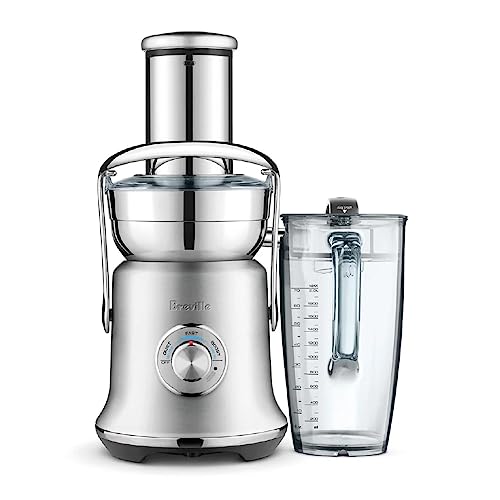
Best fast family pitcher: Breville Cold XL
Breville documents a 3.5-inch chute, XL 70-fluid-ounce seal-and-store jug, quiet and fast settings, and a centrifugal cutting disc with a micro-mesh filter. This is the firm-produce route for families prioritizing rapid apples, carrots, beets, cucumber, and similar compatible ingredients. The large jug can reduce vessel changes, but it does not guarantee 70 ounces of finished juice from any fixed amount of produce.
The Cold XL remains a high-speed basket machine. Plan for mechanical sound, foam, separation, a large pulp container, prompt basket brushing, and substantial sink space. It is less suitable than a slow auger when leafy greens are the family’s central ingredient.
Best family citrus pitcher: Hamilton Beach 66342J
Hamilton Beach 66342J is the specialized choice when the family routine is orange juice, lemonade, or grapefruit rather than mixed vegetables and greens. The maker documents a 34-ounce pitcher, two auto-reversing reamers, and adjustable pulp control. The pitcher supports table service and multiple halved-citrus portions while keeping the mechanism simpler than an all-produce extractor.
Specialization is the reason to buy it and the reason to skip it. It will not process apples, carrots, celery, or kale. Compare fruit size, pulp preference, seed capture, refrigerator plans, and the number of halves an adult will press in one session. Vessel capacity still is not a yield promise.
Best large slow-juicer hopper: Omega JC2022
Omega documents a two-liter, 68-ounce batch hopper, a 70-RPM all-in-one auger without a separate juicing screen, automatic forward-and-reverse pressure detection, a five-minute extraction timer, and a detachable power cord. The hopper can reduce piece-by-piece loading for a family recipe while the screen-free auger changes cleanup relative to conventional mesh systems.
Whole-recipe and “set-it-and-forget-it” wording is manufacturer positioning. Inspect produce, remove pits and excluded material, prepare pieces according to the current instructions, secure every component, and remain available to monitor juice and pulp flow. Choose JC2022 when a large slow-press batch is repeated often enough to justify its footprint and premium position.
Assign the complete family workflow
A workable plan names who buys produce, who washes and cuts it, who operates the juicer, who monitors containers, and who rinses, brushes, inspects, dries, and reassembles the food-contact parts. If cleanup ownership is vague, capacity can make the problem larger. Use a cutting board and sink route that do not cross clean glasses or dry components.
Run the machine in servings the family will finish, not the maximum container size. A batch hopper, chamber, or jug describes part of the appliance; actual output changes with ingredient moisture, trimming, retained liquid, pulp selection, and feeding. Stop before containers overflow and respect every duty limit even when produce remains.
Family juice requires explicit food-safety choices
FDA guidance states that bacteria on raw produce can enter fresh juice and identifies children, older adults, pregnant people, and people with weakened immune systems as groups at greater risk from untreated juice. A home juicer does not pasteurize the drink. Wash hands and sound produce, use clean food-contact surfaces, prevent cross-contamination, and refrigerate juice promptly in clean covered containers.
Do not infer a safe storage window from a vessel name alone. Manufacturer storage positioning for a jug does not replace current public-health guidance, refrigerator temperature control, or advice appropriate to a higher-risk family member. Make smaller fresh batches when the household cannot manage storage consistently.
Sources and further reading
Models relevant to this decision
As an Amazon Associate, we may earn from qualifying purchases.




Frequently asked questions
What capacity does a family juicer need?
Start with the servings the household actually drinks. Hopper, chamber, jug, and pulp-container figures describe different parts and do not guarantee finished-juice volume.
Should children operate a family juicer?
Keep operation and knife work with a responsible adult and follow the exact manufacturer instructions. Safety interlocks and supplied pushers do not turn the appliance into a child-operated product.
Is a centrifugal or slow juicer better for a family?
Centrifugal models favor fast firm-produce pitchers. Slow augers suit families centered on greens, mixed produce, pulp choice, or a quieter feed rhythm. The shared recipe decides.
Does a large sealed jug make homemade juice safe for days?
A jug feature does not pasteurize juice. Follow current food-safety guidance and refrigerator practices, and use extra caution for higher-risk family members.
How can a family reduce cleanup arguments?
Assign preparation, operation, and cleanup before the session. Choose a model whose full rinse, brush, dry, and reassembly sequence one adult can realistically complete every time.
Final verdict
For best juicers for families, compare Ninja NeverClog JC151 and Hurom H400 only after the ingredient, working-space, and cleanup requirements pass. The better choice is the model whose documented tradeoff fits the routine you will actually repeat.