Who should buy the Hurom H400?
Frequent multi-serving or family batches where a large self-feeding hopper, 18.6-ounce chamber, and two-part strainer-free assembly matter more than a smaller stored profile. The right buyer starts with ingredients and routine, not the badge on the front. Write down the produce used most often, the number of servings, the available preparation time, and how much washing feels realistic after an ordinary weekday session.
18.6-ounce chamber, Two-part Easy Cleaning Multi Auger, Self-feeding hopper are the clearest reasons this model enters our shortlist. Each advantage matters only when it removes friction from the main use case. A feature that appears impressive but is used once a month should not outweigh an easier daily feed path, more manageable part set, or better fit under the cabinets.
Who should keep comparing?
Choose H70 for a smaller Easy Clean station, Nama J2 for fine and coarse conventional strainers, Kuvings AUTO10 for a 100-ounce hopper and multiple processing strainers, or a compact model for single servings.
Know before you buy: The 18.5-inch-tall, 14.8-pound body and large hopper need permanent operating, loading, disassembly, and drying clearance. That limitation does not make the product weak. It defines the shopper for whom a different mechanism, capacity, or footprint is the more responsible recommendation.
What the exact model includes
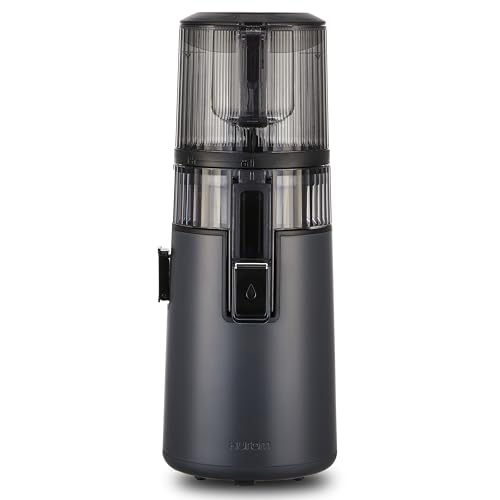
H400 combines a large self-feeding hopper with a two-piece auger that meshes to perform the filtering role without a conventional fine-metal screen. That design changes where residue collects; it does not remove ingredient inspection, safe cutting, pulp monitoring, or cleaning. Hurom lists a 45-millimeter chute opening and warns that large seeds such as peach pits must be removed. Load only compatible pieces with enough room for safe movement, secure the hopper and chamber exactly, use the pusher only as directed, and stop if normal pulp or juice flow changes. The 18.6-ounce chamber is a working-volume specification, not a guaranteed glass count or total hopper capacity. The 90-RPM number belongs to this H400 mechanism and cannot be used as a sound, yield, nutrient, or quality score against the 60/70-RPM H70 table. Hurom lists operation up to 30 minutes continuously; that is an operating limit for the household product, not continuous-duty or commercial certification. Choose H400 when the larger chamber and hopper solve repeated batch friction. Choose H70 when the smaller 6.8-by-8.5-inch base and 17.2-inch height fit better. Confirm the exact matte-black B0BN28HV73 offer, included components, voltage, seller, availability, current support, and warranty terms before purchase.
How the mechanism changes the experience
This model uses a slow auger or press-style extraction path. The mechanism favors controlled feeding and ingredient versatility, while the daily experience depends on feed opening, pulp exit, screen access, and how quickly the parts can be rinsed and rebuilt.
Follow the ingredient from the opening to the extraction surface, juice outlet, and pulp container. That physical path explains more about preparation, pace, texture, and cleanup than a single motor number. Confirm pits, peel, maximum piece size, safety locks, operating limits, and excluded ingredients in the current manufacturer instructions.
Preparation, feeding, and juice texture
Inspect produce and prepare uniform pieces that fit the model guidance. Dense roots, long fibrous stalks, soft fruit, loose greens, and citrus behave differently. Alternate textures when appropriate, avoid forcing the feed path, and allow the machine to clear material before adding more.
Finished texture is influenced by ingredient condition, screen or pulp-control choice, feeding pace, and the recipe itself. Foam, visible pulp, and separation do not establish a universal quality score. Decide whether the household prefers a lighter glass or more body, then compare the model in that context.
Cleanup and long-term ownership
The upper and lower auger pieces detach from one another and from the chamber, which removes a conventional mesh-screen brushing task. Owners still need to separate, rinse, inspect, and dry both auger pieces, chamber channels, juice outlet, pulp path, hopper, pusher, containers, seals, and cap. Strainer-free is not residue-free; Easy Clean is Hurom's design name, not a universal dishwasher instruction. Keep the base and removable power cord dry.
Cleanup starts when the final ingredient clears. Unplug when required, move only approved removable parts to the sink, clear loose pulp, and rinse before residue dries. Pay special attention to the screen, pulp outlet, juice cap, seals, and narrow channels. Keep the motor base dry and follow the current guidance for brushes, dishwasher placement, and reassembly.
Counter space and the complete workstation
Measure more than stored width. Include operating height, hopper or lid movement, produce-bowl space, pulp-container removal, juice-cup placement, the route to the sink, and room for parts to air-dry. A model with a compact body can still require a surprisingly large active station.
Accessibility also affects value. A machine left ready on the counter is easier to use than one that must be lifted from a difficult cabinet and rebuilt every morning. Choose a location that supports the entire cycle: prepare, juice, pour, rinse, inspect, dry, and store.
How JuicerPress evaluates this model
We do not rank a juicer by brand recognition, accessory count, wattage, or one attractive listing phrase. We match the mechanism to the ingredient, remove candidates that fail the routine, and compare the remaining products by their most useful advantage and most important tradeoff.
JuicerPress does not sell, ship, warranty, or accept returns for this product. Verify the exact model, included accessories, seller information, availability, current price, and return terms on Amazon. Product listings and model families can change.
Primary sources checked
Specifications and manufacturer positioning were checked against the current model pages below. JuicerPress separates those documented facts from our editorial workflow advice and does not claim firsthand testing.
Frequently asked questions
What makes H400 an Easy Clean model?
Hurom uses a two-part Easy Cleaning Multi Auger that provides the filtering function without a conventional fine-metal strainer.
What is the H400 chamber capacity?
Hurom specifies 550 milliliters, or 18.6 ounces. That is chamber capacity, not guaranteed finished-juice volume.
How large is the H400?
Hurom lists 6.6 by 10.3 by 18.5 inches and 14.8 pounds. Add hopper-loading, container, disassembly, sink, and drying space.
Does 90 RPM mean H400 is louder or better than H70?
No. RPM describes auger speed within a mechanism; it is not a decibel, yield, taste, or quality comparison.
Can H400 run continuously all day?
No such claim is supported. Hurom lists up to 30 minutes of continuous use for this model.
Why does JuicerPress not show a price?
Amazon prices and availability can change. We send readers to the current product listing instead of publishing a static price that may become inaccurate.
Final verdict
The Hurom H400 is the larger of the two verified Easy Clean models in this batch. Hurom specifies an 18.6-ounce chamber, 90-RPM two-part Easy Cleaning Multi Auger, 150-watt AC motor, 6.6-by-10.3-by-18.5-inch body, and 14.8-pound weight. Its self-feeding hopper and strainer-free assembly favor planned family or multi-serving work, while the height, chamber, pulp container, and detachable pieces make it a permanent station. Hurom's yield, low-pulp, scrub-free, and quiet wording is manufacturer positioning, not JuicerPress testing or a cross-brand guarantee. Choose H70 for a smaller Easy Clean station, Nama J2 for fine and coarse conventional strainers, Kuvings AUTO10 for a 100-ounce hopper and multiple processing strainers, or a compact model for single servings.
As an Amazon Associate, we may earn from qualifying purchases.
Check the current Hurom H400 listing on Amazon ↗