The meaningful comparison covers the entire cycle: safe shutdown, container handling, disassembly, loose-pulp removal, rinsing, screen or strainer brushing, washing, drying, inspection, and reassembly. A machine does not become easy to own because a product page describes one detachable bowl or because a dishwasher can hold several parts.
Start with the ingredient and mechanism, then compare cleanup among machines that can actually perform the repeated job. A citrus reamer may be simplest for oranges but cannot process carrots or greens. A compact centrifugal can be fast for firm produce but still requires careful basket handling. A cold press screen and pulp outlet create a different wet-part routine.
Choose the correct mechanism before cleaning features.
Count the complete wet set, not only the main bowl.
Include drying and correct reassembly in the time estimate.
What current manufacturer documentation confirms
Ninja currently states that the JC151 has simple assembly and dishwasher-safe juice-contact parts. Breville's BJE200 manual names the juicer cover, integrated pulp container, Nutri Disc, and juice jug as top-rack dishwasher-safe while excluding the food pusher. Cuisinart directs owners to rinse the CCJ-500 juice container, reamer and sieve assembly, and cover before placing them on the top rack.
Breville's 800CPXL manual identifies the stainless-steel filter, fruit dome, juicing cone, and juice collector as dishwasher-safe and keeps the motor base and press arm in the wipe-only path. Those facts belong to those exact models and components. The verified BLACK+DECKER CJ625 route remains a value citrus comparison; its exact current instructions should be checked before every dishwasher decision.
Cold press models need screen and outlet access
Ninja JC151 is the leading all-produce cleanup path because its evidence and everyday mechanism align: pulp choice is handled by two filters, assembly is described as simple, and juice-contact parts carry the dishwasher statement. Prompt filter inspection remains necessary after berries, celery, greens, or dense roots.
Omega All-in-One represents a horizontal path with the auger and screen arranged toward the front. Omega Hands-Free reduces active loading through a hopper but adds a larger chamber and lid. These alternatives belong because geometry changes the routine, not because JuicerPress assumes dishwasher equivalence. Read the exact manual for every food-contact part.
Centrifugal cleanup centers on the basket
Breville Juice Fountain Compact integrates pulp collection into a smaller station and includes a cleaning brush. Its manual provides unusually precise care evidence: the cover, integrated pulp container, Nutri Disc, and juice jug are top-rack dishwasher-safe, while the food pusher is not. It also tells owners to brush and visually inspect the micro-mesh basket.
That mixed map is the lesson. A centrifugal machine can have several dishwasher-approved pieces while the cutting basket remains the part that decides daily willingness. Handle sharp areas safely, remove wet pulp promptly, and compare whether the integrated bowl fits the actual sink and drying rack.
Dedicated citrus can minimize the wrong kind of complexity
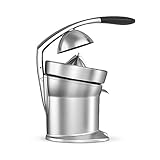
Cuisinart CCJ-500 is the compact adjustable-pulp route. Its manual names a rinse-first top-rack sequence for the juice container, reamer and sieve assembly, and cover. Breville Citrus Press Pro adds an assisted arm and a dishwasher-safe filter, dome, cone, and juice collector, but its heavier powered frame remains on the counter for wiping.
BLACK+DECKER CJ625 offers the value pitcher-style citrus path already verified in JuicerPress's citrus work. Choose among these by fruit, serving size, hand motion, vessel needs, sink space, and exact care map. A larger list of dishwasher pieces does not make a citrus-only machine suitable for vegetables.
Rinsing before pulp dries is the universal habit
Across mechanisms, prompt model-approved rinsing is more useful than waiting for residue to harden. Set out the brush and clear a drying zone before juicing. After safe shutdown, remove bulk pulp into an appropriate waste or compost container, protect the drain, and rinse only the components authorized for running water.
Prompt does not mean unsafe. Wait for movement to stop, unplug as directed, handle baskets and screens by safe surfaces, and never aim water at a powered base. Sticky citrus, fine greens, celery fibers, berry seeds, and pigmented roots leave different residue, so the correct tool and cleaning intensity remain ingredient-aware.
Screen reachability outranks vague convenience
Look at both sides of a filter or basket, the frame where mesh joins, and the route toward the pulp outlet. Confirm that the supplied or approved brush reaches these surfaces without bending mesh or putting fingers near cutting teeth. A transparent or open path can simplify inspection even when the part is hand-washed.
Avoid knives, pins, wire brushes, and harsh abrasives unless the exact instructions expressly call for them. If ordinary approved cleaning does not restore a clear screen, consult the model's maintenance guidance. Repeated blockage may be a feeding, ingredient, assembly, or screen-choice problem rather than a reason to scrub harder.
Drying space can eliminate an otherwise good pick
A large hopper, bowl, lid, pulp bin, juice vessel, screen, auger, and small seals may occupy more drying area than stored dimensions suggest. A compact centrifugal concentrates pieces but can create awkward nesting. A citrus reamer uses fewer kinds of parts but leaves sticky residue on the cone and sieve.
Measure the counter-to-sink route and drying rack before buying. Parts should drain without unstable stacks, hidden water, or small components slipping away. Reassembly should happen only with clean, appropriately dry parts and correctly seated seals. If the kitchen cannot accommodate the wet set, a smaller-capacity model may be the better long-term tool.
Replacement parts support cleaner ownership
A damaged screen, torn seal, cracked bowl, warped lid, lost brush, or loose locking tab should not be solved with an improvised substitute. Check exact model support and current replacement availability before purchase. Similar appearance is not compatibility, especially around pressure, electrical interlocks, or the food path.
Inspect parts while they dry under good light. Stop using structural damage rather than trying to clean it away. Keep model-specific brushes, caps, and seals organized. The ability to identify and replace a wear component can support a reliable routine more meaningfully than an accessory bundle that adds unused pieces.
Final easy-clean shopping test
Write the primary ingredient, usual servings, safe cleanup time, sink dimensions, drying area, hand-wash tolerance, dishwasher schedule, and the component most likely to cause avoidance. Eliminate any model with the wrong mechanism or an unmanageable wet set. Then verify the exact manual and current Amazon configuration.
Choose Ninja for mixed-produce cold press convenience, Breville Compact for fast firm-produce work, Cuisinart for compact adjustable-pulp citrus, Breville Citrus Press Pro for assisted citrus, or an Omega when its specific horizontal or hopper workflow solves a bigger problem than dishwasher access. The winner is the machine whose complete routine will be finished, not postponed.
Choose a model pathway
Easy-to-Clean Juicers separates the shortlist into 3 practical routes: documented all-produce cleanup, documented dedicated-citrus cleanup, cold press geometry alternatives. Start with the route that matches the dominant routine, then read its exact model review before opening the retailer listing.
Documented all-produce cleanup
Choose Ninja for cold press with dishwasher-safe juice-contact parts or Breville Compact for centrifugal speed with an exact mixed dishwasher and brush map.
Ninja JC151 is the strongest broadly useful easy-clean choice in the current catalog because its cold press mechanism, straightforward assembly, and manufacturer-documented dishwasher-safe juice-contact parts align. Breville Compact is the fast firm-produce alternative with a precise top-rack map, while Cuisinart and Breville Citrus Press Pro are stronger when citrus is the only repeated job. Choose an Omega only when its feed geometry solves a more important daily problem. Every winner still requires prompt pulp removal, screen inspection, full drying, and correct reassembly.
Use the Juicer Finder to test the ingredient, routine, space, and budget decision before purchasing.
Frequently asked questions
What is the easiest juicer to clean?
Ninja JC151 is the strongest documented cold press starting point here; dedicated citrus models can be simpler when citrus is the only job. Mechanism, part access, sink fit, and reassembly determine the answer.
Are dishwasher-safe parts enough to make a juicer easy to clean?
No. Screens may still need brushing, residue should be removed promptly, and drying and reassembly remain part of the routine.
Which juicer parts should be checked first?
Prioritize the screen or basket, pulp outlet, cap, seals, bowl channels, containers, and any area where mesh joins a frame.
Do cold press juicers have fewer parts than centrifugal juicers?
Not universally. Compare the exact food-contact set and part geometry instead of relying on mechanism labels.
Can a motor base go in the dishwasher?
No. Powered housings, cords, plugs, and controls must stay dry and be cleaned only by the approved wipe method.
Why are no cleanup times promised?
Batch size, ingredients, sink layout, user familiarity, washing method, and drying conditions vary too much for a universal time promise.